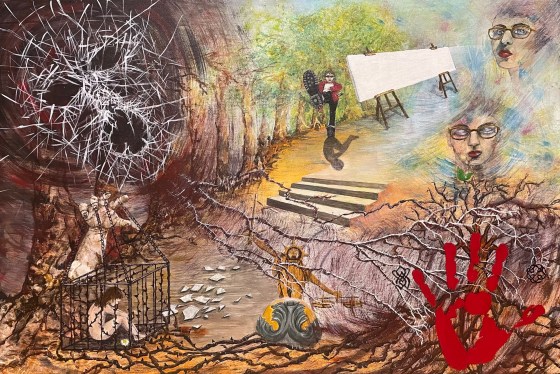
This painting is the most figurative of my recent works. It is fuelled by my being more open and explicit about my past and its legacy. I still wish to leave the viewer with ‘room’ for alternate interpretations.
Our homes are practical objects. They are built to give us shelter and a place to live. To many the home is usually linked to stability, security, happy families and protection. We use them to work, play, socialise, and entertain our friends. They also offer us with a place to relax and rest. We personalise them to make it familiar, which in turn can make it comfortable; physically, mentally, or both. We do this by investing our personalities, status, securities, wealth, memories and identities in these structures. But we also rely on the emotional value of home.
The idea of home has a meaning for everyone. We often speak of our hometown, our birthplace, family background, nostalgia of a time, place, and home with fond reverie. It is a place where one can locate their identity.
A ‘home’ is the house we make our own.
Gaston Bachelard once said:
Our house is our corner of the world – Our first universe – In the life of a human being, the house maintains the person through the storms of the heavens and through those of life.
Home is a space where the occupants are hidden from view, locked away behind closed doors, surrounded by enclosing walls. These walls give us the privacy that offers the only reliable hiding place from the rest of the public gaze. They are the places in which we usually hold memories of family and childhood events.
On the other hand, the home can also be a place of conflict, abuse, loneliness, entrapment and fear. Concealed from public view it holds things hidden from human eyes.
There are many who have no safe haven. Some people have lost or never had that protection. They have no place to live or a place to call home.
Homelessness not only brings a loss of home but also brings a sense of isolation and estrangement. Many people, like me, have moved house many times. I have also been homeless (a young teenager) and experienced the isolation, loneliness and feelings of abandonment. I do not have childhood memories of a safe, warm and loving environment. Thus, my concept of ‘home’ is somewhat tainted.
I believe Marianna Torgovonick sums up the ambiguities of home in the foregoing:
Home is the place we live, lungs expanding and contracting, air clean and healthy, loving parents, wholesome children, all that in sync. Home is the place of shelter; protection against natural and man-made catastrophes, doors locked and barred to violence and destruction, windows open to the world but able to shut at will. That’s why the plight of refugees, or civilians in wars, of the homeless, is so terrifying. No place to live, no place to shelter, no place to get away from it all. Home is the Utopian ideal, home is what we have to believe is safe, where we have to carry on as though it will be safe. Home is the last frontier.
My dream home is a where I will feel at peace.
Oh, and it will have a large studio so I can paint and dance to my hearts content!
If you had a million dollars to give away, who would you give it to?
If I had a million dollars to give away, I would give it to:
Women’s aid: A National charity working to end domestic abuse against women and children.
Shelter: A charity that supports homeless people.
NAPAC: The National Association for people abused in childhood.
PTSD UK: Dedicated to raising awareness of PTSD.
All of the above, have helped, supported, and guided me through all of my childhood and adult traumatic experiences. I would not be here today without them ❤️🙏



 Sara Allwright Fine Art